The Owner's Compensation Dilemma: How Much Should You Pay Yourself?

As a business owner, how do you decide how much to pay yourself?
For many owners, the answer comes down to a quick look at the business bank account and whatever seems available to take out.
Pay yourself too little, and you wind up funding business growth out of your own pocket. Pay yourself too much, and you can leave too little room for the business to handle taxes, reinvestment, or a slower stretch.
No universal formula exists for calculating owner compensation. Your entity type, cash flow, market compensation, tax situation, and future business plans all play a role in determining what makes sense.
Key Takeaways
Getting your salary wrong as a business owner can create tax and cash flow problems for you and your business.
Sole proprietors and partners don’t set a salary, but they generally owe tax based on their share of business income, regardless of how much cash they actually withdraw.
S-Corp owners who perform services for the business must take reasonable compensation before taking non-wage distributions.
Treating a draw or distribution like a paycheck can leave you short when the tax bill on the underlying profit is due.
Why “Whatever is Left” Isn’t a Compensation Strategy
The most common pitfall owners fall into with salary is guessing instead of choosing a deliberate number. It might be what’s left after everything else or a gut feeling, but it isn’t based on a consistent plan.
This approach has two outcomes:
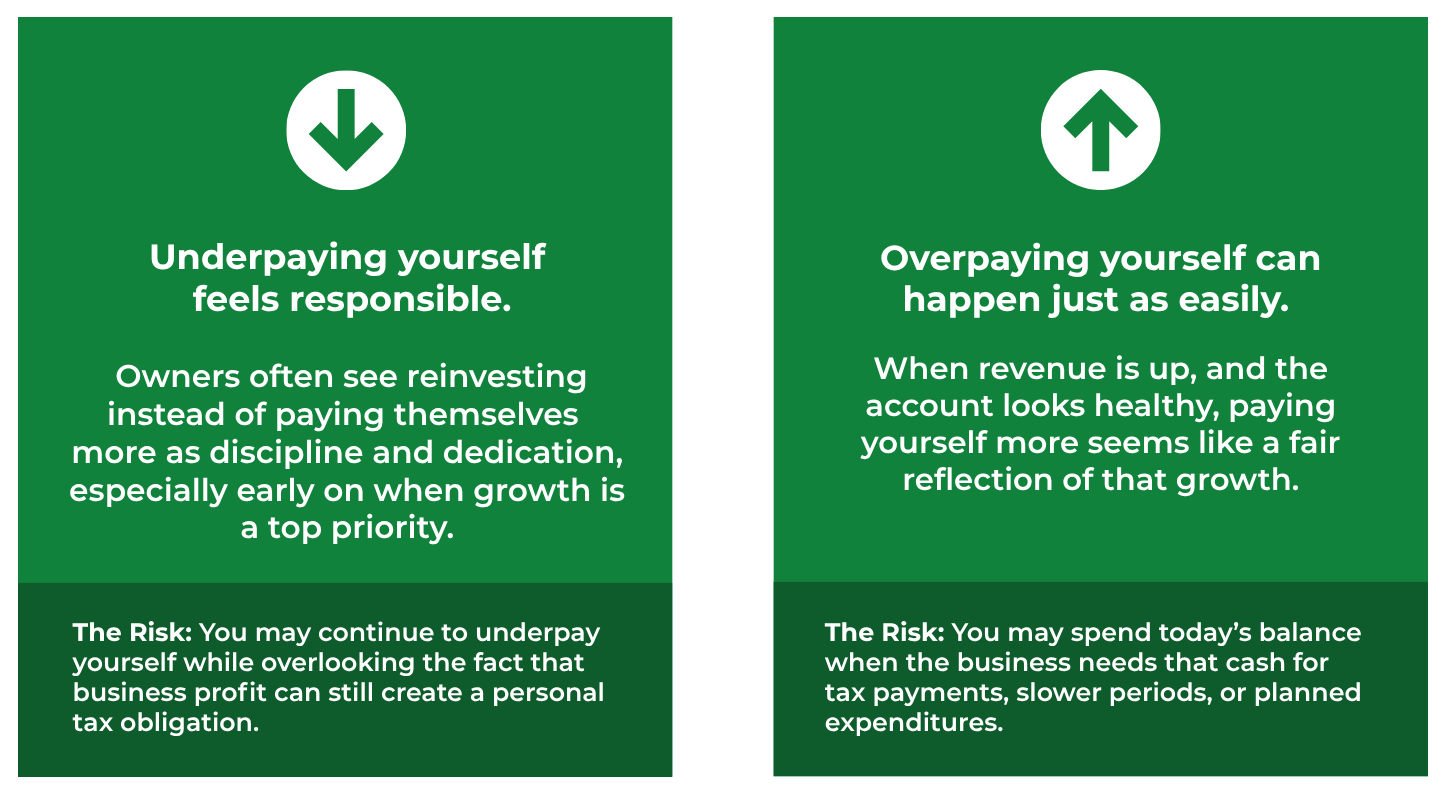
In both cases, the bank balance is making the decision instead of a compensation plan.
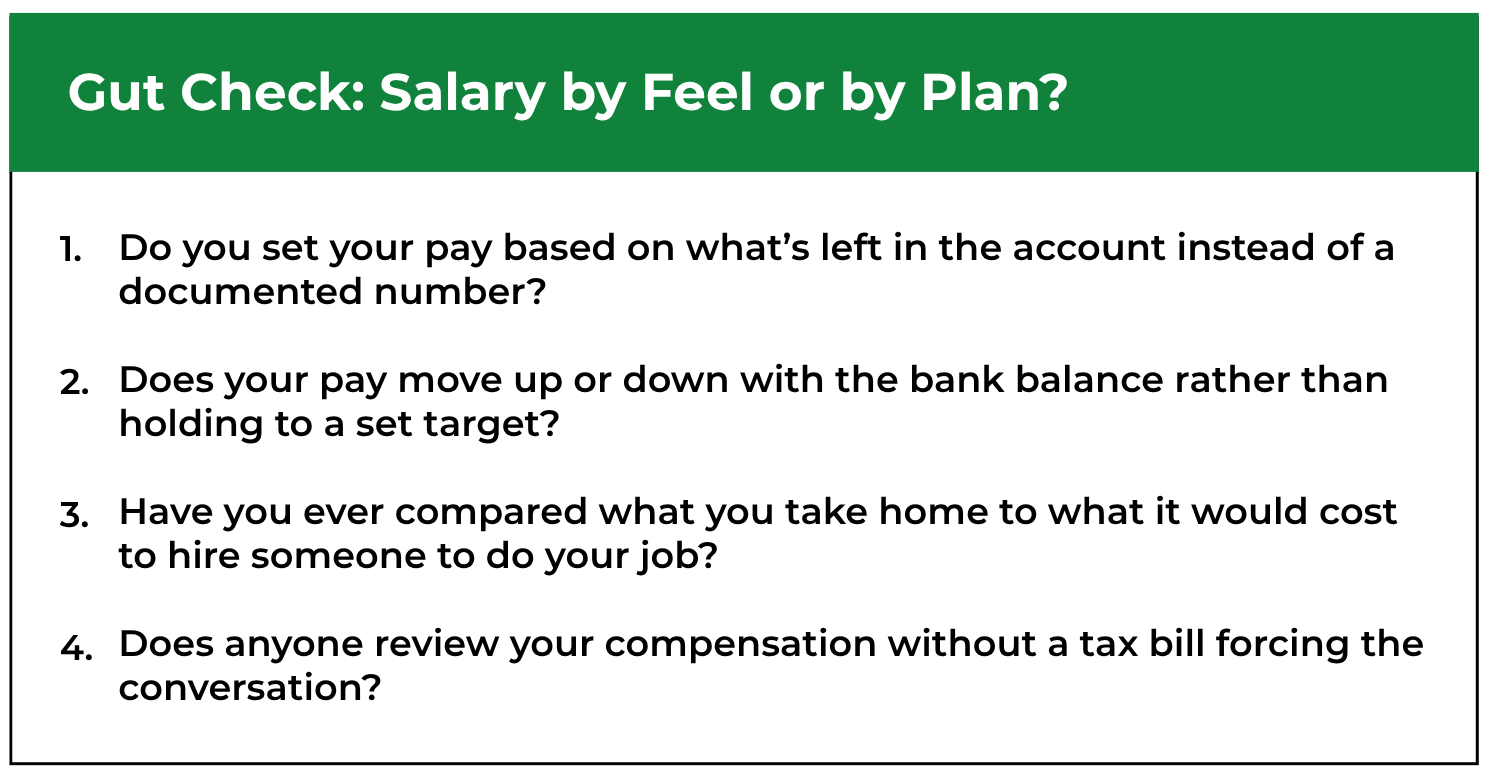
If some of these sound familiar, your compensation may be reacting to circumstances rather than following a plan. The first variable to consider is your business structure.
Your Formula Depends on Your Business Entity
Your business entity type affects how you pay yourself and how that compensation is taxed.
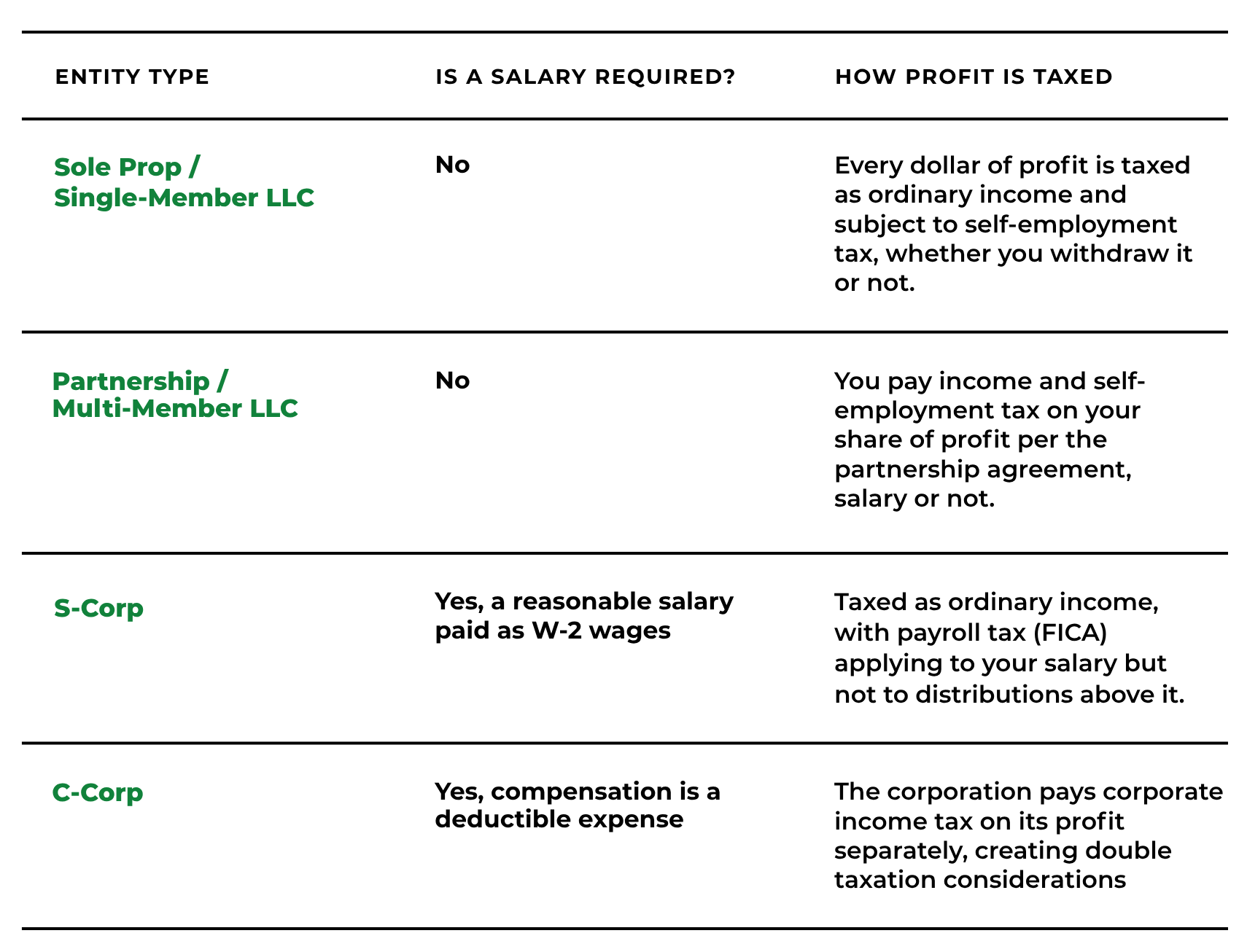
Note: Standard S-Corps in California are also subject to a franchise tax: 1.5% of net income or $800 per year, whichever is greater. Each state has its own rules, so be sure to check what may be required to pay for the state(s) you are doing business in.
S-Corp owners must pay themselves reasonable compensation as W-2 wages before taking additional profit as distributions. A salary that’s too low relative to distributions can attract IRS scrutiny, while setting it too high can erode the tax savings that make the S-Corp election worthwhile in the first place.
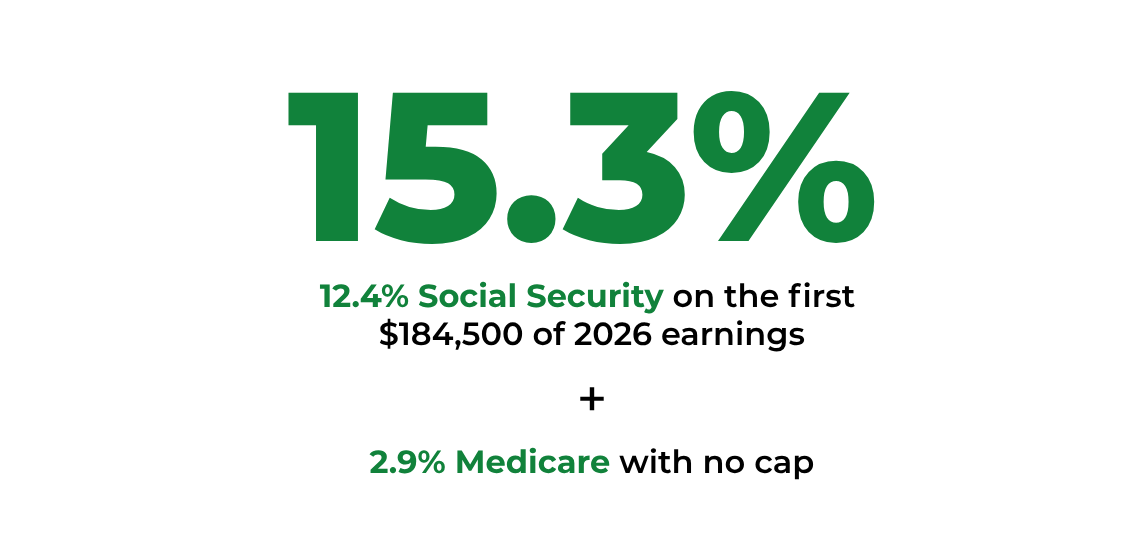
Sole proprietors and partners pay this as self-employment tax on their full share of profit. For an S-Corp shareholder-employee, the same combined rate for Social Security and Medicare (15.3%) applies to W-2 salary as payroll tax (FICA), split between the business and the employee.
This is because the IRS treats a shareholder who performs services for the company as an employee for tax purposes. (IRS, S Corporation Employees, Shareholders and Corporate Officers)
Distributions above that reasonable salary aren’t subject to either self-employment or payroll tax, only income tax.
What’s A “Reasonable Salary” for an S-Corp Owner?
When determining what to pay yourself, weigh these factors to find a number that’s fair to you and doesn’t leave the business exposed:
What a comparable role would cost to fill in the open market
Your business’s cash flow stability (not just this year’s total profit)
Personal financial needs beyond the business
Growth plans that require capital to stay in the business
The tax impact of the mix between salary and distributions
Whether payroll tax, retirement contributions, or benefits are tied to your compensation number
State-specific costs, including California’s S-Corp franchise tax
The economics of an S-Corp election also depend, in part, on whether business profit meaningfully exceeds a reasonable salary once the additional tax and compliance costs are considered.
If you want to see the dollar math on when S-Corp status pays for itself versus when compliance costs outweigh the savings, read:
Related Reading: The Real Cost of S-Corp Conversion (And When It’s Worth It)
How to Think About Draws and Distributions
For tax purposes, draws (for sole proprietors, single-member LLCs, and partnerships) and distributions (for S-Corps) aren’t considered compensation in a pass-through entity. They’re a withdrawal of equity you’ve already paid or will pay tax on.
This is reported on Schedule K-1 for S-Corps and partnerships and Schedule C for sole proprietors and single-member LLCs.
Say an S-Corp is owned by a single shareholder-employee whose reasonable salary works out to $90,000 based on the factors covered above.
The numbers might look like this:
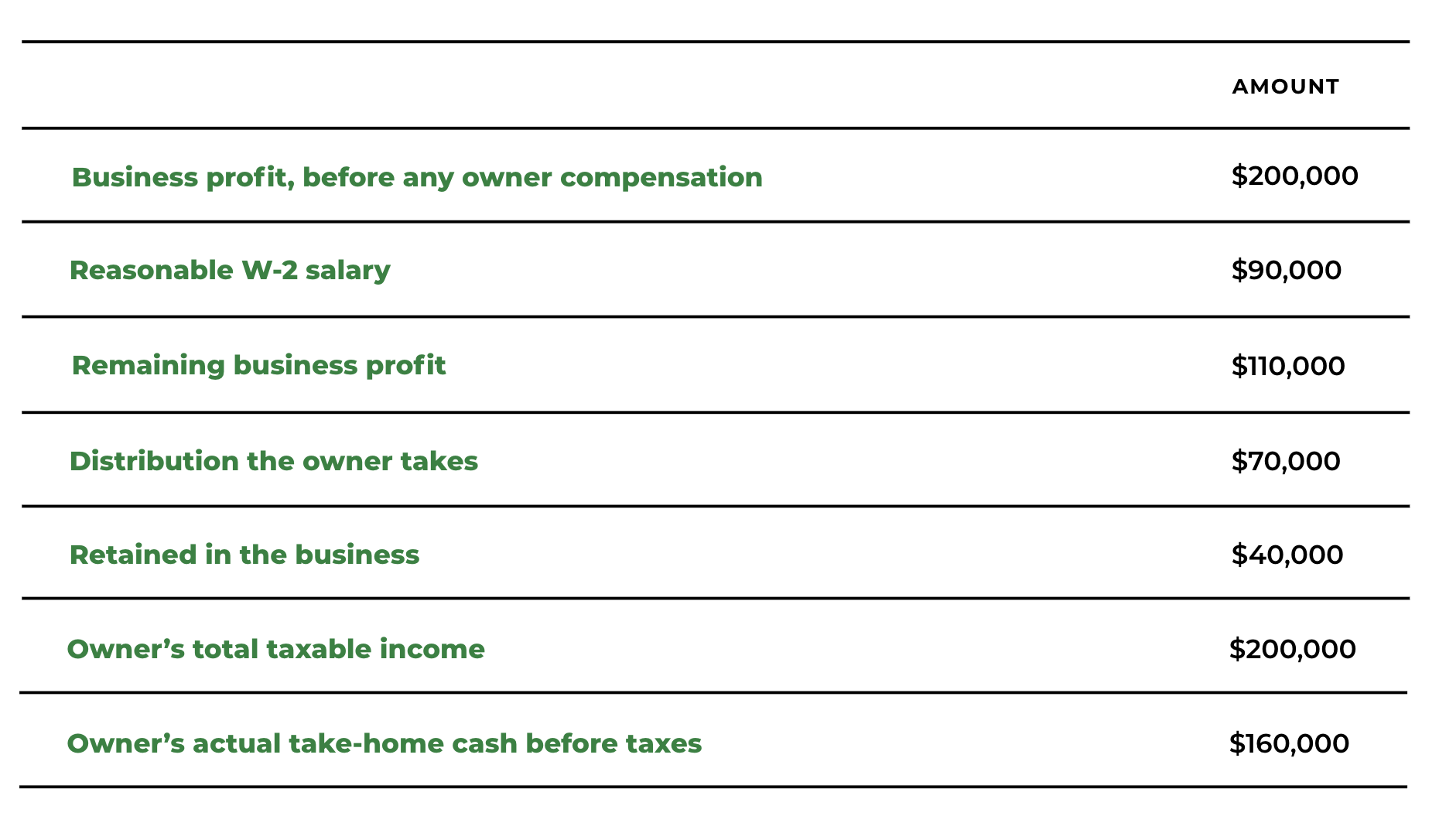
The $110,000 in remaining pass-through profit after taking a reasonable W-2 salary does not automatically become a distribution. For a single shareholder-employee, the owner decides how much to pay out and how much to leave in the business for cash reserves or reinvestment.
If there’s more than one shareholder, distributions generally must follow the ownership percentages, since S-Corps are required to maintain a single class of stock with identical distribution rights.
While a pro-rata rule governs the distribution split, company bylaws or shareholder/operating agreements outline whether to make a distribution and how much. In practice, this is usually by majority vote by ownership share, board approval, or unanimous/supermajority consent. Salary is still set individually for each shareholder-employee’s own role. Shareholders are taxed on their ownership share of business profit.
Regardless, the owner owes tax on the full $200,000 (salary plus pass-through profit, distributed or not). The salary portion is subject to FICA and ordinary income tax, while the remaining profit is subject to ordinary income tax but not FICA.
S-Corp owners may get into trouble if they assume they'll be taxed only on what they drew, rather than on the full business profit.
Sole proprietors and partners don’t have a salary to separate, so the entire profit is subject to self-employment and income tax to the owner in the year it’s earned, whether or not any is withdrawn from the business.
Your actual reasonable W-2 compensation will vary depending on your role and circumstances; this example is for illustration only and is not a recommendation for any individual. If you would like assistance determining reasonable compensation for your S-Corp owners, we can provide a reasonable compensation study that can be used in defense of a potential IRS audit.
Related Reading: The Top 4 Tax Traps Most Business Owners Fall Into
Your Action Plan: Choosing Compensation That’s Fair to You
A sound compensation number comes from a deliberate process that accounts for several factors.
Start with your entity’s rules. If you’re a sole proprietor or partner, this is a cash flow decision, as every dollar of profit is already taxed to you personally. If you’re an S-Corp, start with a reasonable compensation analysis before any distributions.
Price the role, not yourself. Find out what it would cost to hire someone to do your job in your market, and use that number as an anchor.
Build in a buffer. Set aside cash for taxes, slow seasons, and significant expenses you know are coming before deciding what to pay yourself.
Separate compensation from distributions. Treat your salary as compensation for the work you perform. Evaluate distributions separately based on profit, cash flow, your entity structure, and the capital the business needs to retain.
Put a date on your next review. What’s fair to pay yourself changes as your business grows. What made sense at $150,000 net income likely won’t at $1 million. Revisit your compensation at least once a year, or any time profitability or the business itself changes significantly.
Accurate, current accounting gives you the visibility to evaluate what the business can support alongside your personal income, deductions, other investments, and tax obligations.
Are There Financial Blind Spots In Your Business?
Setting owner compensation depends on having accurate, timely financial information.
If your books are behind or you don’t have a clear view of cash flow and other financial operations, it becomes harder to make informed decisions about what the business can support.
The Fagan & Fagan Financial Health Scorecard asks 16 questions about your financial operations and gives you a color-coded assessment of what’s working and what may need improvement. You’ll also receive a short, personalized video analysis with three specific tips.
It takes less than four minutes to complete.
Frequently Asked Questions (FAQs)
Q: Can I change my salary partway through the year?
A: Yes, as an S-Corp owner, you can adjust W-2 wages going forward at any point, though changes typically apply to pay periods ahead, not retroactively.
Q: Does paying myself a higher salary reduce my QBI deduction?
A: It can affect the calculation. The Qualified Business Income deduction excludes W-2 wages, so model your reasonable compensation number against that deduction.
Q: If my business has a loss, do I still need to pay myself a salary?
A: A sole proprietor or partner has no salary requirement either way. For an S-Corp owner, a cash-strapped year can affect timing or amount, but it doesn't eliminate the requirement. Reasonable comp should still be run through payroll, even if it's modest, as long as the owner is performing services. If the owner is actively working in the business, the reasonable comp rule still applies, since the requirement is based on the value of the work performed, not on whether there is profit to distribute.
Content in this material is for general information only and is not intended to provide specific advice or recommendations for any individual.